
Prepaid Smart Water Meter Compliance: STS, Smart Card, and Regional Requirements
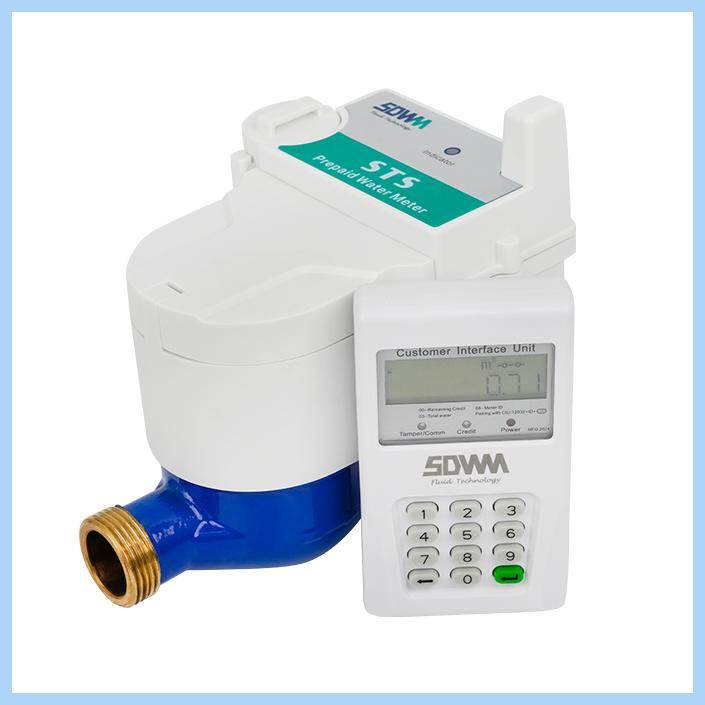
A prepaid water meter has to pass two separate compliance gates before a utility can deploy it legally. The first gate is metrological: the meter must be approved as a legal measuring instrument under the standards the destination market enforces. The second gate is prepayment security: the mechanism that carries credit onto the meter — an STS token or a smart card — must be issued under an approved scheme, and the firmware that validates that credit must itself be certified.
Most procurement failures in this category come from collapsing those two gates into a single question — "is it CE certified?" — and then discovering, after the container has shipped, that the certificate covers a different model range, that the firmware loaded on the delivered meters is an older version than the one quoted, or that a validity date expired before commissioning.
This guide sets out what has to be verified, in what order, and which document answers each question. It draws on the product and certification records of Shengda Water Meter Co., Ltd. (SDWM), a water meter and flow meter manufacturer established in 1995 in Kaifeng, China, which supplies prepaid, smart and postpaid meters under OEM/ODM arrangements from a 66,000 m² facility with an annual output of 3 million units. The two prepaid families referenced throughout are the LXS-S STS prepaid water meter and the LXSK / LXLK smart card prepaid water meter, with the LXSG postpaid meter used as a control for the differences.
Problem Definition: Why Prepaid Meters Carry a Heavier Compliance Burden Than Postpaid Meters
A postpaid meter has one functional obligation: measure and register volume accurately, and — if it is a smart model — transmit that register. A prepaid meter adds four obligations on top, and each one produces a document a buyer has to check.
- Measurement approval. The meter still has to be a legal measuring instrument. Type examination, accuracy class and the permitted size range all sit in the metrology file.
- Credit authenticity. The meter must be able to distinguish a genuine credit token or card from a forged one. For token systems this is where STS enters: STS is the globally recognized security standard for prepaid water meter encryption systems, referenced as IEC 62055-41/51.
- Control behaviour. The meter interrupts supply when credit reaches zero and restores it when credit is loaded. Valve control, overdraft rules and purchase limits therefore become part of the acceptance test, not an operational afterthought.
- Commercial configuration. Step tariffs, historical consumption records, vending through mobile payment or PC, and integration with third-party payment systems all have to be configured and documented before handover.
The practical consequence is that prepaid procurement fails in ways postpaid procurement rarely does. A postpaid meter that arrives with the wrong communication module is a project delay. A prepaid meter that arrives with an uncertified firmware version, or a certificate whose size range stops below the sizes actually delivered, is a meter that cannot be legally commissioned or billed.
There is also a documentation-layer problem that is easy to miss. Certificates are issued for a defined scope — a model, a size range, a standard edition — and for a defined validity window. A file that is correct in every respect except its scope is not usable evidence. Buyers who treat a PDF as a general proof of quality rather than as a scoped, dated instrument tend to discover the gap at the worst possible moment.
Industry Background: The Market Context Behind Prepaid Compliance Pressure
Smart metering has moved from pilot projects into mainstream utility planning, and prepayment sits inside that shift rather than beside it.
- The global smart water meters market was valued at USD 9.1 billion in 2024 and is projected to reach USD 16.2 billion by 2030, according to Grand View Research.
- Advanced Metering Infrastructure held a 58.9% share of the smart water meter market in 2024, per Precedence Research — meaning most new meters are being bought as part of a networked reading system rather than as stand-alone devices.
- The residential segment accounted for 67.2% of smart water meter adoption in 2024, based on Cognitive Market Research figures. Residential deployment is where prepayment is most often used, because that is where revenue collection risk concentrates.
- Concentration is high at the top of the market: Bluefield Research reports that the top 20 water metering vendors, including Itron, Badger Meter and Sensus, accounted for 76% of global market share in 2024. Buyers sourcing outside that group are, by definition, relying on documentation rather than on brand familiarity to establish compliance.
- Asia Pacific is the fastest-growing region for smart water meters, driven by urbanization in China and India, according to MarketsandMarkets.
Market sizing in this category should be read with care. Published 2024 global figures diverge sharply — Grand View Research at USD 9.1 billion, Bluefield Research at USD 6.8 billion, MarketsandMarkets at USD 4.61 billion — largely because some reports count only networked 'smart' meters while others include the broader water meter market. The divergence is a useful reminder for compliance work too: scope definitions matter more than headline numbers.
The compliance implication of all this is straightforward. As meters become networked, metered and payment-linked at the same time, the value of a shipment depends on the paper that travels with it. A utility buying 10,000 prepaid units is not buying 10,000 measuring devices; it is buying a metrology approval, a prepayment scheme credential, a firmware version and a tariff configuration, replicated 10,000 times.
Detailed Solution: Building the Compliance Stack for STS and Smart Card Prepaid Meters
Compliance for a prepaid meter is best built as four layers, checked in sequence. Each layer answers a different question, and each can be verified from a specific document.
Layer 1 — Metrological approval: is this a legal measuring instrument?
The metrology layer defines whether the meter may be used for billing. The recurring references are the ISO 4064 series for water meters, OIML R 49 for metrological and technical requirements, and — inside the European Economic Area — MID 2014/32/EU. European Commission and CEN references state that smart water meters are required to comply with EU Directive 2014/32/EU (MID) and EN 14154-4:2023 for legal metrology in the EEA.
SDWM's metrology file includes Technical Construction Files for MID 2014/32/EU covering the LXS, LXLC, LXSY and LXLY models from DN15 to DN800, prepared against EN ISO 4064-1:2017, EN ISO 4064-2:2017 and EN ISO 4064-4:2014 with Shenzhen ZTL Testing Technology Co., Ltd. Separately, EU-Type Examination certificates (MID Module B) exist for specific families: MID-2759-2000003 for the LXSY series DN15–DN20 issued by SASTEK, MID-2759-2200018 (Rev.01) for LXH-DN15 and LXH-DN20 mechanical cold water meters, and M4 69267376 0001 issued by TÜV Rheinland for the LXC / LXC-V IoT ultrasonic meters.
The point for a prepaid buyer is that metrology approval is model-specific. An approval for a postpaid LXSY does not transfer to a prepaid LXS-S, and an approval for DN15–DN20 does not cover DN50.
Layer 2 — Prepayment scheme: is this credit mechanism approved?
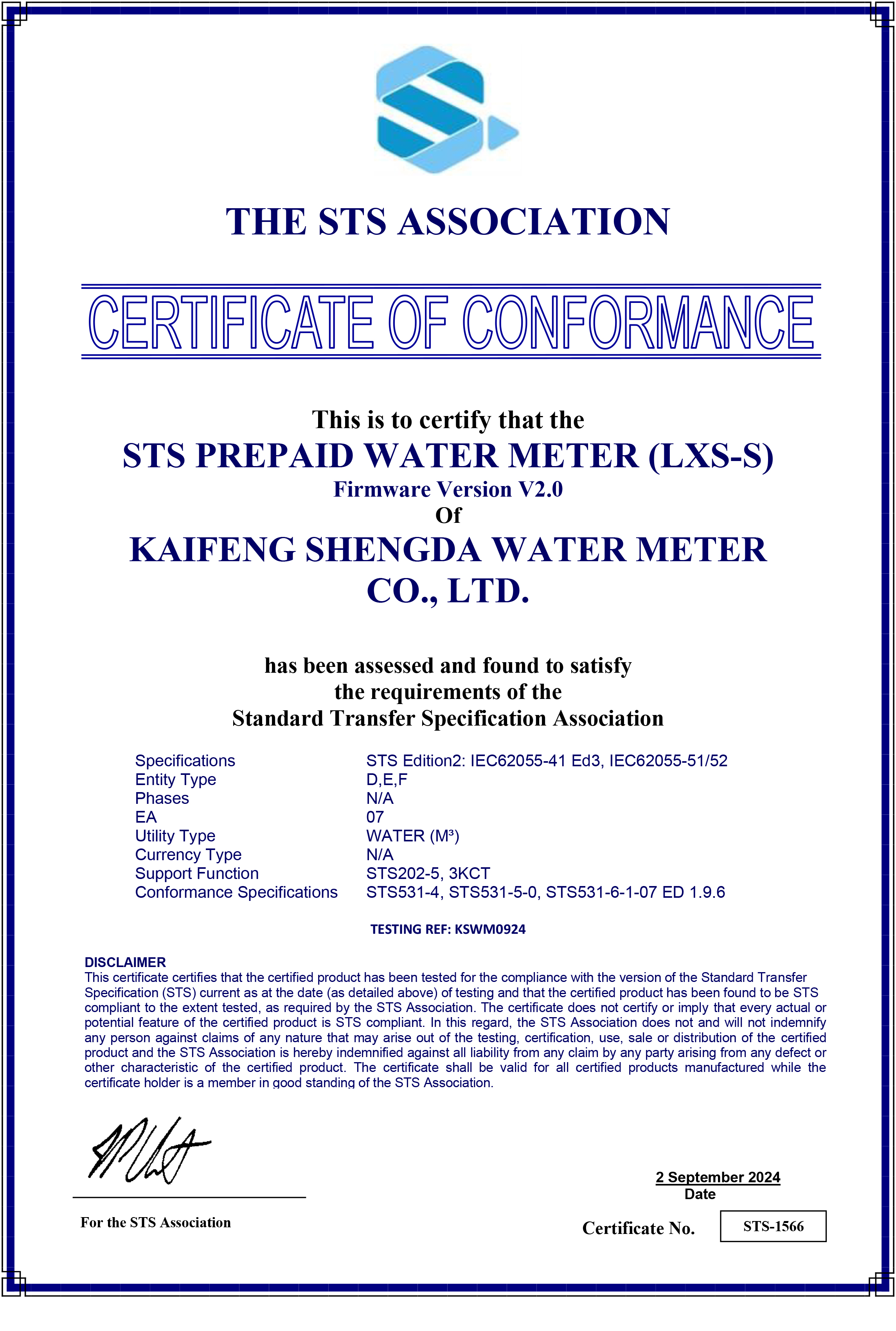
For token-based prepayment, STS is the reference scheme. SDWM holds an STS Association Membership Certificate, number 2026019, issued by the STS Association, valid from 2026-01-01 to 2050-01-01. The prepayment firmware is separately certified: STS Firmware Version V2.0, certificate number KSWM0924, issued by the STS Association and scoped to STS Token-based Prepayment System products under the STS Standard.
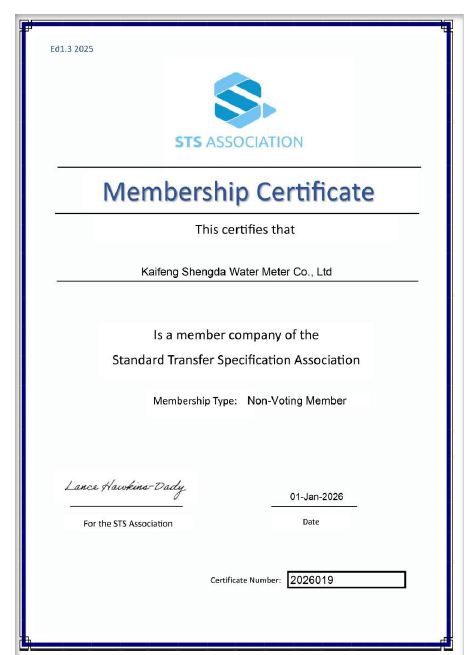
Membership and firmware certification are not interchangeable. Membership establishes that the supplier participates in the scheme; the firmware certificate establishes that a specific software version generates and validates compliant tokens. When a manufacturer updates firmware, the version changes, and the question of whether the new version is covered becomes a real procurement question rather than a technical detail.
The LXS-S is a token water meter: the meter, a keypad and the payment software form the delivery package, and the meters support 20-digit STS tokens, as used in the Zimbabwe municipal deployment described later in this article.
Layer 3 — Product-level CE and safety files for the prepaid families
The third layer is where most document sets are either complete or exposed as incomplete. The table below lists the certificate files SDWM holds that are relevant to prepaid and adjacent meters, including issuer, scope and validity window. Every figure is taken from the certificate record, not from a datasheet.
| Certificate / file | Issuer | Scope | Standards referenced | Validity |
|---|---|---|---|---|
| STS Association Membership Certificate, No. 2026019 | STS Association | STS prepayment scheme participation (global) | STS Standard | 2026-01-01 to 2050-01-01 |
| STS Firmware Version V2.0, No. KSWM0924 | STS Association | STS Token-based Prepayment System | STS Standard | 2026-01-01 to 2050-01-01 |
| CE ATTESTATION, No. 0H240702.KSWT076 | ECM | STS Prepaid Water Meter LXS-S, sizes DN15 to DN300 as listed | EN 14154-1:2005+A2:2011; EN 14154-2:2005+A2:2011; ISO 4064-1:2014; ISO 4064-2:2014; ISO 4064-4:2014; OIML R 49-2:2013 | 2024-07-02 to 2029-07-01 |
| CE ATTESTATION, No. 0H240702.KSWT077 | ECM | Prepaid Water Meter LXSK DN15–DN300; LXLK DN50–DN300 | EN ISO 4064-1:2017/A11:2022; EN ISO 4064-2:2017/A11:2022; EN ISO 4064-5:2017/A11:2022; EN 14154-1:2005+A2:2011; EN 14154-2:2005+A2:2011; EN 14154-4:2023 | 2024-07-02 to 2029-07-01 |
| EU-Type Examination (MID Module B), No. MID-2759-2000003 | SASTEK | LXSY series water meters, DN15–DN20 | 2014/32/EU MID Module B; EN ISO 4064-1:2018; EN 14154; OIML R 49-1:2013 | 2020-10-30 to 2030-10-30 |
| EU-Type Examination (MID Module B), No. M4 69267376 0001 | TÜV Rheinland | LXC / LXC-V IoT ultrasonic water meters | 2014/32/EU MID; EN ISO 4064-1:2017+A11:2022; EN ISO 4064-2:2017+A11:2022 | 2024-10-14 to 2034-10-13 |
| CE Declaration of Conformity, No. HK2405221265S | HUAK | Ultrasonic water meter LXC (enclosure protection) | EN 60529:1991+A1:2000+A2:2013 | 2024-05-28 to 2034-05-28 |
| RoHS certificate, No. KTi260528R1441C | Kti | LXC series ultrasonic water meters | IEC 62321-1:2013; IEC 62321-2:2021; IEC 62321-3-1:2013; IEC 62321-4:2013+A1:2017; IEC 62321-5:2013; IEC 62321-6:2015; IEC 62321-7-1:2015; IEC 62321-7-2:2017; IEC 62321-8:2017 | 2026-06-04 to 2036-06-04 |
| ISO 9001:2015 Quality Management System, No. 31624010128R3M | CEOC Testing & Certification Center (Beijing) Co., Ltd. | Quality management system | ISO 9001:2015 | 2021-04-09 to 2027-04-01 |
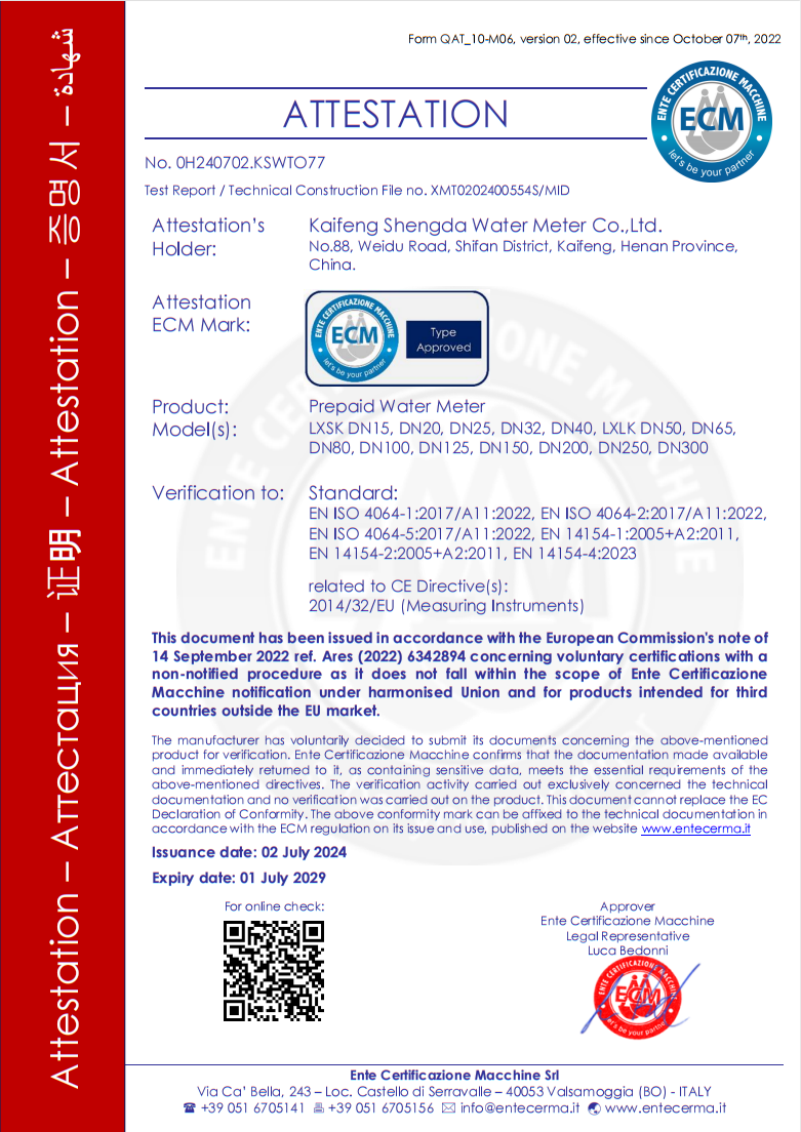
One detail in this table deserves emphasis because it is the kind of detail that decides a tender. The LXS-S CE certificate lists sizes from DN15 up to DN300, while SDWM's published LXS-S product specification covers DN15 to DN200. A buyer ordering within DN15–DN200 is inside both documents. A buyer needing above DN200 should obtain written confirmation of coverage before committing, rather than assuming that the certificate's upper bound applies to the whole product line.
Layer 4 — Regional requirements you cannot assume from a CE file
Regional requirements differ in kind, not merely in degree, and a single European file does not satisfy a market that regulates prepayment separately.
- EU / EEA. CE marking and MID 2014/32/EU are the metrology baseline, with EN 14154-4:2023 referenced for additional functionalities. Electrical and electronic compliance is a separate matter: the RoHS certificate for the LXC series is issued under the IEC 62321 series and runs to 2036-06-04. Enclosure protection is also separately evidenced — the IP68 claim for the LXC is supported by a Declaration of Conformity to EN 60529:1991+A1:2000+A2:2013, not by the metrology certificate.
- Markets that mandate STS. Where the utility's vending system is built on STS, token generation must come from certified firmware and the vendor must be inside the scheme. The practical documents are the STS Association membership certificate and the firmware certificate, plus proof that the shipped firmware version matches.
- Local utility acceptance. Beyond international standards, most utilities apply their own acceptance criteria: tariff structure, overdraft policy, valve behaviour, communication method and the format of the monthly data extract. These are commercial documents, but they are as binding as any certificate, and they should be captured in the technical specification before order placement.
- Postpaid comparison. A postpaid meter such as the LXSG carries a lighter document set because it has no payment credential. Its specification lists CE, MID and ISO 4064 certification as optional, and its compliance question is essentially metrology plus communication. Prepaid buyers who ask for 'the same certificates as our postpaid project' are usually missing the prepayment layer entirely.
Step-by-Step Breakdown: Seven Checks Before You Approve a Prepaid Meter Shipment
The sequence below is written to be run in order. Each step produces either a document or a written confirmation, and each one closes a specific failure mode.
- Fix the configuration in writing. Record the model, size range, body material and functional options before any certificate is discussed. For the LXS-S, the published specification covers DN15–DN200, a brass or cast iron body (cast iron for bulk sizes), flow ratios of R80, R100 and R160, a maximum working pressure of 1.0 MPa, IP68 protection, working voltage of 3.6 V ± 0.6 V and quiescent current of ≤10 μA. Without a locked configuration there is nothing to compare the certificate against.
- Match certificate scope to the ordered configuration. Check model designation and every size in the order. A certificate listing DN15 to DN300 is evidence for DN200 but says nothing about DN350.
- Verify the prepayment credentials at scheme level. Request the STS Association Membership Certificate (for SDWM, No. 2026019) and the firmware certificate (No. KSWM0924, STS Firmware Version V2.0). Then ask for a written statement that the firmware in production equals the certified version — the certificate proves the version, not the shipment.
- Check validity dates against the commissioning date. Certificates expire. For illustration, the ISO 4064 / EN 14154 certificate No. 4Z210830.KSWTN30 covered the period 2021-08-30 to 2026-08-29, while the prepaid-specific CE certificates No. 0H240702.KSWT076 and 0H240702.KSWT077 run to 2029-07-01. Both patterns are normal; what matters is which window the delivered meters fall into, and whether a renewal or re-issue letter is on file.
- Test the prepayment workflow, not just the meter. The LXS-S specification lists the functions that should be exercised on a sample before a volume order: automatic valve control, insufficient-water warning, self-defined overdraft, anti-storage (purchase limitation), step price setting, historical data retention, payment by mobile or PC, and use of third-party payment systems. Also confirm the anti-magnetic interference record and low-battery / anti-tamper detection, since those two functions are the audit trail when consumption is disputed.
- Verify the environmental and electrical envelope. Confirm IP68 sealing against the installation environment, pressure loss of ≤0.063 MPa, a water temperature range of T30 to T90 for the prepaid meter, battery life of up to 8 years, and LORA-RF (UIU) communication where a local reading unit is part of the architecture.
- Verify the system behind the certificate. A certificate issued to a factory is only as good as the factory's process control. SDWM operates under ISO 9001:2015 (No. 31624010128R3M), ISO 14001:2015 (No. 31626E00146R301), ISO 45001:2018 (No. 31626S00140R30) and a five-star Commodity After-sales Service Certification to GB/T 27922-2011 (No. 31626FWO0009R300). Quality control at unit level covers incoming material inspection, production process inspection, 100% functional testing, calibration testing and final inspection before shipment.
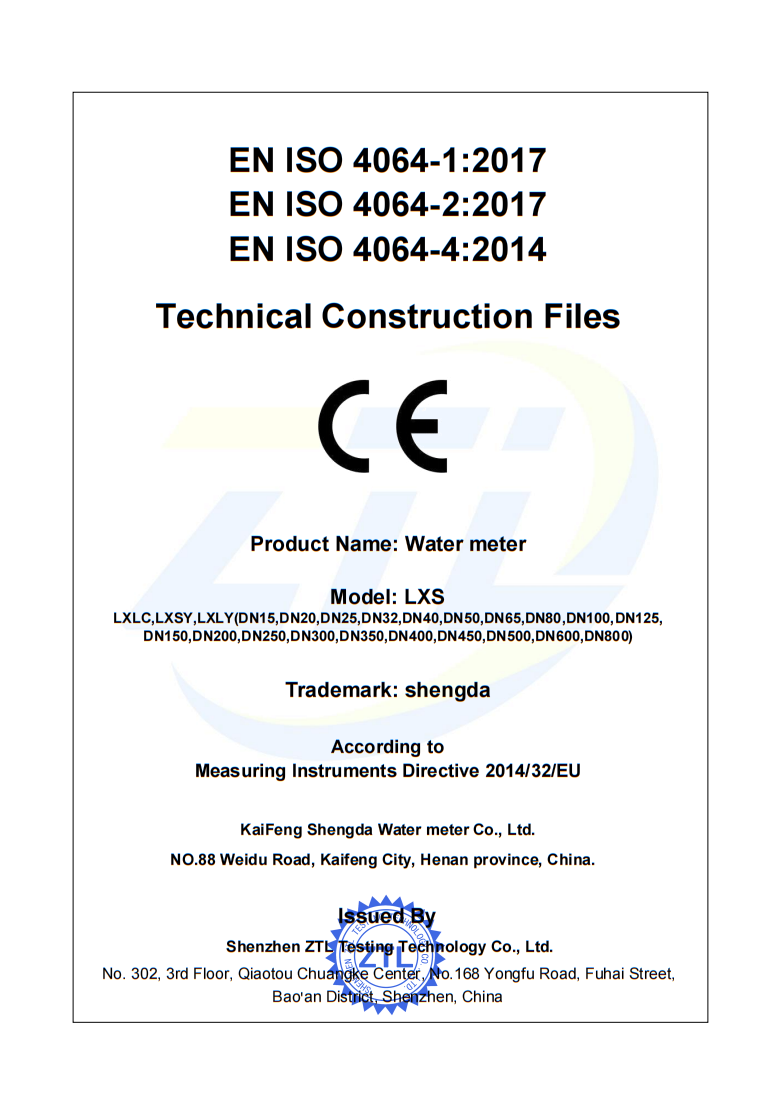
The documentation pack that should travel with a prepaid shipment is therefore: the model-specific metrology file, the CE attestation covering the prepaid models ordered, the STS membership and firmware certificates, the RoHS file where electronics are involved, the enclosure protection declaration where IP68 is claimed, and the factory's quality management certificates. Anything less leaves the commissioning team to argue the point on site.
Use Cases: Where Prepaid Compliance Requirements Bite in Practice
Compliance requirements become concrete when a project has to be commissioned, billed and audited. Four deployment patterns illustrate the difference between a meter that passes inspection and one that passes operation.
Municipal water supply with token vending — Zimbabwe
A municipal water supply project in Zimbabwe deployed more than 4,000 units for smart water management and water loss control, running for over 8 years, and achieved remote recharge, automatic billing and user management. The deployment highlights the two features that only a compliant token meter can deliver: support for 20-digit STS tokens and remote valve control — both of which depend on certified firmware rather than on hardware alone.
Government tender with OEM branding — Sudan
A water utility in Sudan took delivery of more than 10,000 units for residential water metering, awarded through a government tender and running for over 10 years. The project was delivered as an OEM solution with customer branding and long service life as the stated performance priorities. In tender-driven procurement the certificate pack is typically a scored item, and OEM documentation has to be consistent with the certificates held.
Networked residential metering — Kenya
A municipal water department in Kenya deployed more than 20,000 units over more than 8 years using NB-IoT communication, improving automatic meter reading efficiency and reducing manual maintenance costs. This is the pattern where a buyer who needs prepayment later discovers that the metrology and communication files are in place but the prepayment layer is not — the two are scoped separately.
Smart card prepayment in residential buildings
Card-based prepayment fits buildings where residents reload credit locally rather than through a vending network. The smart card prepaid models LXSK (DN15–DN300) and LXLK (DN50–DN300) are covered by CE attestation No. 0H240702.KSWT077 against EN ISO 4064-1/-2/-5:2017/A11:2022 and EN 14154-1/-2/-4, valid to 2029-07-01. SDWM's prepaid product data lists household, dormitory, hotel, residential property, apartment and warehouse applications, with bulk sizes used for irrigation, water resources management, industrial production and garden management.
Comparison Table: STS Prepaid vs Smart Card Prepaid vs Postpaid
The table compares the three options using published product data and certificate records only. It is intended to show where the compliance burden sits in each case, not to rank the options — the correct choice depends on the vending infrastructure the utility already operates.
| Parameter | STS prepaid water meter (LXS-S) | Smart card prepaid water meter (LXSK / LXLK) | Postpaid water meter (LXSG) |
|---|---|---|---|
| Credit medium | STS token entered via keypad | Smart card | No prepayment — consumption billed periodically |
| Size range | DN15–DN200 (product data) | LXSK DN15–DN300; LXLK DN50–DN300 | DN15–DN50 |
| Body material | Brass; cast iron for bulk sizes | As specified on the CE attestation scope | Brass / stainless steel / nylon (optional) |
| Flow ratio | R80, R100, R160 | Not stated in the certificate record | R100, R160, R200, R250, R400 (optional) |
| Prepayment scheme documents | STS Association Membership No. 2026019; STS Firmware V2.0, No. KSWM0924 | CE attestation No. 0H240702.KSWT077 | None applicable |
| Metrology documents | CE attestation No. 0H240702.KSWT076 (EN 14154-1/-2, ISO 4064-1/-2/-4, OIML R 49-2) | CE attestation No. 0H240702.KSWT077 (EN ISO 4064-1/-2/-5, EN 14154-1/-2/-4) | CE / MID / ISO 4064 listed as optional |
| Validity window | 2024-07-02 to 2029-07-01 | 2024-07-02 to 2029-07-01 | Depends on option selected |
| Pressure / protection | Max working pressure 1.0 MPa; IP68 | As specified on the CE attestation scope | PN10 / PN16 |
| Battery life | Up to 8 years | As specified for the model | Lithium battery optional |
| Communication | LORA-RF (UIU) | As specified for the model | LoRaWAN / NB-IoT / 4G / RS485 / M-Bus / pulse (optional) |
| Best fit | Utilities with an STS vending network and remote recharge requirement | Buildings and estates reloading credit locally | Utilities billing on metered consumption |
| Main compliance risk | Firmware version on delivered meters differing from the certified version | Assuming the LXS-S STS certificate also covers card models | Assuming the postpaid file covers a prepaid purchase |
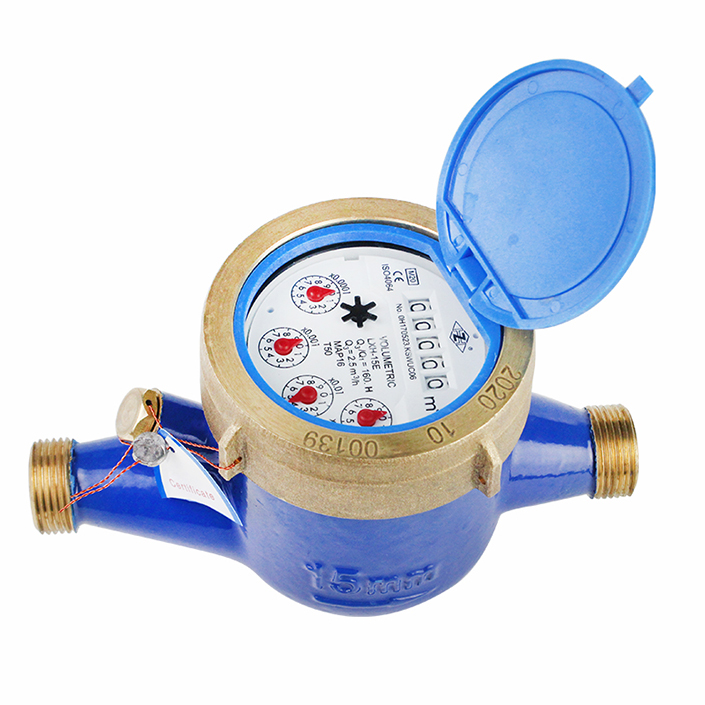
Two misunderstandings recur when buyers compare these options. The first is treating the STS certificate as a product certificate: it covers the scheme and the firmware, not the meter's metrological accuracy. The second is assuming a card meter and a token meter share documentation because both are 'prepaid'. At SDWM they are covered by two separate CE attestations — 0H240702.KSWT076 for the LXS-S and 0H240702.KSWT077 for the LXSK / LXLK — which is why the model number on the purchase order has to be the model number on the certificate.
FAQ
1. Is STS certification enough on its own for a prepaid water meter?
No. STS covers the prepayment security layer — SDWM's file includes STS Association Membership Certificate No. 2026019 and STS Firmware Version V2.0 under certificate KSWM0924 — but it does not establish that the meter is a legal measuring instrument. Metrological approval is a separate file: for the LXS-S it is CE attestation No. 0H240702.KSWT076, which references EN 14154-1:2005+A2:2011, EN 14154-2:2005+A2:2011, ISO 4064-1:2014, ISO 4064-2:2014, ISO 4064-4:2014 and OIML R 49-2:2013 and is valid from 2024-07-02 to 2029-07-01. A buyer needs both documents, valid at commissioning.
2. What prepayment functions should be verified on a smart card prepaid meter before shipment?
Verify what the meter actually does when credit runs out, because that behaviour is what the utility will be audited on. The prepaid product data for SDWM covers automatic valve control, insufficient water warning, self-defined overdraft, anti-storage (purchase limitation), configurable step prices, historical data retention, payment by mobile or PC, and use of third-party payment systems. Also confirm anti-magnetic interference recording and low-battery / anti-tamper detection, plus IP68 protection and pressure loss of ≤0.063 MPa where those matter to the installation.
3. What drives the commercial scope of a prepaid meter order?
The commercial scope is determined by configuration and quantity rather than by a single list figure. On the software side, the LXS-S prepayment package is supplied with free payment software and can integrate with third-party payment systems. On the production side, SDWM's capability data sets a minimum of 3 units for samples and 500 pcs for customized OEM projects, with monthly capacity of more than 100,000 units across water meters and flow meters. Requesting a quotation against a locked configuration — model, size range, body material, communication and prepayment options — is the only way to compare offers on equal terms.
4. Can we test a prepaid meter before committing to a project order?
Yes. SDWM's minimum order quantity for samples is 3 units, which is enough to run a bench test of token or card entry, valve behaviour, tariff configuration and data extraction before a volume commitment. Standard products ship in 15–20 days. Testing on a sample is also the only reliable way to confirm that the firmware version on delivered hardware matches certified version V2.0, since a certificate documents the version and not the shipment.
5. How long does delivery take for a customized prepaid order, and what documentation ships with it?
Customized products are quoted at 30–40 days depending on project requirements, against 15–20 days for standard products. The shipment should be accompanied by the model-specific metrology file, the CE attestation matching the ordered prepaid models, the STS membership and firmware certificates where token prepayment applies, and the factory quality certificates (ISO 9001:2015, ISO 14001:2015, ISO 45001:2018). To start a project-specific compliance review, send the model, size range and destination market to SDWM — contact details and the company profile are in the next section.
Conclusion: Compliance Is a Scope Question Before It Is a Quality Question
Prepaid water meter compliance is not a single certificate to be collected and filed. It is a set of scoped, dated documents — metrology approval, prepayment scheme credential, certified firmware, safety and environmental declarations, and the factory system that reproduces them at unit level — each covering a defined model, a defined size range and a defined validity window.
The STS prepaid LXS-S, the smart card prepaid LXSK and LXLK, and the postpaid LXSG each carry a different document set, and none of those sets can be substituted for another. The buyers who avoid commissioning problems are the ones who lock the configuration first, then match certificates to it, then check the dates, then test the workflow on a sample before the volume order ships.
Next Step: Request the Compliance Pack for Your Market
SDWM can assemble a project-specific documentation pack covering the model or models you are evaluating, the certificate copies listed in this article, a written firmware version statement, and a sample meter for bench testing before a volume commitment.
Contact: Miranda — admin@henanpanda.com / +86 18603780816 · WhatsApp
Company profile (PDF): Download the SDWM profile
Website: www.sdflowmeter.com
Have Questions or Need More Details?
Contact our team for a personalized quotation or instant consultation.
Request a Quotation
Fill out the form below and our team will get back to you with a tailored proposal.
WhatsApp Direct Chat
Prefer to chat in real-time? Message us on WhatsApp for instant assistance & quick answers.
- Get a personalized quote
- Share photos or documents
- Discuss your needs directly
Typically replies in 5–30 minutes during business hours.