
Battery Power vs Plug-In Magnetic Flow Meters: Comparison
Battery Power vs Plug-In Magnetic Flow Meters: A Water Flow Meter Comparison
Battery power and plug-in are not two settings on the same switch. In the electromagnetic flow meter range described by Shengda Water Meter Co., Ltd. (SDWM), plug-in is one of three installation methods — integrated, split and plug-in — while battery power describes how the meter's electronics are energised. A water flow meter project that treats the two labels as a straight either/or is usually comparing a power decision with an installation decision, and can end up approving a configuration that satisfies neither the site nor the contract.
This comparison separates the two axes. It sets out what each label actually classifies, which parts of a project specification belong to which axis, and which purchasing terms and acceptance criteria a buyer should fix in writing before an order is placed. Statements about SDWM products come from the company's own published information; statements about standards and market context are attributed to their issuing bodies or publishers. Where a model-level value is not published, this article says what must be confirmed rather than filling the gap with a number.

The real problem: two labels from two different specification axes
The practical difficulty starts in the tender document. A line item reads "battery powered magnetic flow meter" or "plug-in magnetic flow meter", the evaluation compares unit prices, and the technical annex is written later. Because the two phrases come from different axes, the comparison then mixes questions that should be answered separately.
A buyer at decision stage actually has to settle three things for any measuring point:
- Can the meter be installed here? Pipe size, pipe material, available straight run, access for the sensor, and whether the line can be taken out of service.
- Can the meter be powered and read here? Whether a supply exists at the point, who maintains it, and how the flow signal reaches the utility's telemetry or billing system.
- Can the delivered unit be verified against the contract? Calibration records, pressure and sealing tests, material documentation, communication checks, certificate scope, and the acceptance procedure.
Only the second question belongs to the battery axis. Only the first belongs to the installation axis. The third applies to both, and it is the part most often left out of the purchase order.
Industry background: what the standards and the market establish
Electromagnetic flow measurement is a mature technique with a documented physical basis. As described in an OIML certificate for an electromagnetic water-meter family, the conductive medium flows through a magnetic field and induces a voltage between the electrodes that is proportional to mean flow velocity. That principle is why conductivity matters, why the pipe must run full, and why wetted-material choices affect both signal and service life.
Several published documents frame the qualification work:
- ISO 6817:1992 describes the principle and main design features of industrial electromagnetic flowmeters.
- ISO 20456:2017 gives guidance for the use of electromagnetic flowmeters for conductive liquids in closed conduits, and ISO 9104:1991 sets out methods for evaluating the performance of electromagnetic flowmeters for liquids. Both matter because a quoted accuracy figure is only comparable when the test basis behind it is stated.
- ISO 4064-1:2014 and OIML R 49-1 address water meters for cold potable water and hot water. They are parallel requirement frameworks from different institutions; the applicable one depends on the destination market's legal metrology regime, and they should not be averaged or treated as interchangeable.
- In the European Union, Directive 2014/32/EU contains instrument-specific Annex MI-001 on water meters, and Directive 2014/34/EU (ATEX) governs equipment for potentially explosive atmospheres where an Ex-rated variant is required.
- IEC 61326-1 covers EMC requirements for measurement and control equipment, and IEC 60529 is the source of the IP code used for enclosures. NSF/ANSI 61 is the US scheme for health effects of drinking water system components, which addresses wetted materials rather than metrological accuracy.
Market context is secondary to the buying decision but useful for framing it. Flow Research reported that the worldwide market for all types of flowmeter technologies totalled USD 8.4 billion in 2025, with revenues forecast to reach USD 10.4 billion in 2030, and identified Coriolis and magnetic flowmeters as the revenue leaders. That describes the whole flowmeter market, not the size of any single configuration, and it does not tell a project buyer which option fits a specific chamber, pipe or approval route.
What "battery power" classifies — and what it leaves open
Battery power classifies the energy source of the meter's electronics. It is a configuration that exists in the electromagnetic meter market: ABB technical documentation, for example, references battery-powered meters together with OIML R49 requirements. That reference establishes that the configuration is a recognised product category; it does not establish what any particular model's battery service interval, logging behaviour or approval scope is.
For a project, the battery axis generates its own specification list, and every item on it should be answered in writing by the supplier:
- Energy budget and service interval. How long the meter is expected to operate between battery services, and what that expectation assumes about measurement interval and data transmission frequency.
- Service access. Whether the battery is replaceable on site, what tools and access are needed, and whether the installation point allows a service visit at all.
- Status signalling. How low battery or a power fault is reported to the utility, so the meter does not fail silently between reading cycles.
- Reading and communication arrangement. Which output or protocol is used, how it is powered, and how the reading enters the billing or SCADA process.
- Enclosure protection for the actual location. SDWM's stated control measures for its electromagnetic meters include IP68-rated sensors for underground or submerged installation, and IP68 waterproof protection for flooded or outdoor sites; the applicable rating still has to be confirmed for the exact model and cable arrangement ordered.
What "plug-in" classifies — and why terminology must be checked
SDWM's published classification groups electromagnetic flow meters by installation method into integrated, split and plug-in types. Plug-in therefore sits on the installation axis. It does not, by itself, tell a buyer what power supply the transmitter uses, what accuracy class applies, or which approvals the model holds.
Terminology is the trap here. Different manufacturers use overlapping words — insertion, clamp-on, spool piece, wafer — and a buyer who assumes that one supplier's "plug-in" is geometrically identical to another supplier's "insertion" product may discover the difference at the installation stage rather than the evaluation stage. Before the term is accepted in a technical annex, request the model drawing and confirm:
- how the sensor enters the pipe and what the pipe wall interface looks like;
- the pipe material and wall thickness range the design covers;
- whether the line must be taken out of service for installation;
- the sealing arrangement and the pressure test applied to it;
- whether the transmitter is mounted locally or separately, since SDWM lists split and integrated as distinct installation classes;
- the zero-check and commissioning procedure after installation.
Side-by-side comparison for a water flow meter project
| Decision dimension | Battery power magnetic flowmeter | Plug-in magnetic flow meter |
|---|---|---|
| What the name classifies | Power supply of the meter's electronics. Documented as a product category in manufacturer technical literature (ABB documentation referencing battery-powered meters and OIML R49). | Installation method. SDWM classifies electromagnetic flow meters as integrated, split and plug-in types. |
| Primary site question | Is there a dependable supply at the measuring point, or must the meter run from its own energy source? | Can the sensor be installed at this pipe section, and can the line be opened or taken out of service? |
| What must be quoted by the supplier | Battery type, expected service interval and the assumptions behind it, replacement procedure, low-battery signalling, communication arrangement. | Model drawing, pipe interface dimensions, wall-thickness range, sealing arrangement, installation and zeroing procedure. |
| Power and data | Confirm separately how readings are obtained and transmitted, and how that transmission is powered. | Not defined by the term. Confirm transmitter supply, output protocol and enclosure protection for the installed location. |
| Media-related risk | Same as any electromagnetic meter: conductivity, liner compatibility, electrode corrosion. SDWM states liner options of PTFE, rubber, PFA or FEP and electrode options including Hastelloy C, titanium or SS316, selected by medium. | Same media risks, plus the sealing interface created by the installation itself, which is tested before shipment and should be re-checked on site. |
| Verification focus at acceptance | Calibration record, battery and service documentation, communication test record, enclosure protection for the installed position. | Conformity with the approved drawing, pressure and sealing test record, calibration record, commissioning zero check. |
| Where public evidence is thin | No model-level battery-life or duty-cycle figures are published in the material used for this comparison. | No model-level dimension, pressure-rating or connection-standard matrix is published in the material used for this comparison. |
Step-by-step decision path
Step 1 — Fix the measuring point before the product name
Record pipe size, pipe material, wall thickness, available straight run, burial depth or chamber dimensions, and whether the pipe can be isolated. A configuration that cannot be installed is not a cheaper option; it is a rework order.
Step 2 — Characterise the water, not just the pipe
Electromagnetic meters need a conductive medium. SDWM's stated selection measures include recommending suitable models for low-conductivity liquids, matching PTFE, rubber, PFA or FEP liners to the medium, and choosing Hastelloy C, titanium or SS316 electrodes according to the application. Potable water, raw water, treated effluent and food-process water rarely share the same material answer, and the material decision changes price without changing the label on the purchase order.
Step 3 — Decide power as its own question
Ask whether a reliable supply exists at the point, who maintains it, and what happens during an outage. If the answer is no supply, battery power becomes the relevant axis and the supplier must state the service interval and replacement procedure. If the answer is a dependable supply, the battery axis may be irrelevant to the site — but do not assume that a "plug-in" label settles the power question, because the term classifies installation, not supply.
Step 4 — Decide installation access
Confirm whether the pipe can be opened, whether a shutdown window exists, and who performs the installation. For a plug-in configuration, the drawing and the sealing arrangement become the controlling documents. For any configuration, the commissioning check after installation should be agreed in advance, including how a zero reading is verified with the line full and static.
Step 5 — Define accuracy together with its test basis
An accuracy figure quoted without a test method and test conditions is not comparable across suppliers. Reference the applicable method (for example ISO 9104:1991 for performance evaluation, and the water-meter framework that applies in the destination market) and require the calibration certificate to state the points tested. SDWM's stated measures include 100% calibration and accuracy testing before shipment and multi-point calibration before shipment for long-term stability; the certificate supplied with the order should show what was actually performed for that unit.
Step 6 — Define communication and data requirements
SDWM's stated measures include testing LoRaWAN, NB-IoT, 4G or M-Bus communication before delivery, and support for encrypted communication. For a utility project, the protocol is only half the requirement; the other half is what the utility's head-end system expects, and whether the delivered configuration has been tested against that expectation.
Step 7 — Fix the approval route for the destination market
Decide which document the utility or regulator will actually check: a metrological approval under the destination market's water-meter regime, a wetted-material approval for potable water, an Ex certificate for a hazardous area, or all three. ATEX, MI-001, OIML R 49, ISO 4064 and NSF/ANSI 61 address different things, and one document does not substitute for another.
Step 8 — Write purchasing terms and acceptance criteria into the order
This step converts the technical decision into an enforceable order. It is covered in its own section below, because it is where most disputes originate.
Use cases: three conditional examples
The following are illustrative situations, not reported projects. They show how the two axes change the decision, and each would need the supplier's model documentation to become a real specification.
Example A — District metering in a chamber with no local supply
If a metering chamber has no dependable mains feed and a service visit is practical, the power axis dominates: battery power is the relevant configuration and the specification should centre on service interval, replacement procedure, low-battery signalling and how readings are collected. The installation axis then follows the chamber geometry.
Example B — Retrofit on a large transmission main
If the pipe is large, the shutdown window is short, and replacing a full-bore spool is impractical, the installation axis dominates. Here a plug-in configuration — the installation class SDWM lists alongside integrated and split — is the one to examine, and the controlling documents are the model drawing, the pipe interface, the sealing test and the commissioning plan. Power is then a separate question to confirm with the supplier.
Example C — Process water in a food or beverage plant
If the water is product-contact water, wetted materials and cleanability documentation drive the selection, and a sanitary electromagnetic flow meter variant may be needed. In that case neither the power label nor the installation label is the first decision; the first decision is the material and hygiene documentation the plant's quality team will accept, and the exact scheme should be named by that team rather than assumed from a general catalogue.
Limitations and boundaries a buyer should keep visible
- The labels are not specifications. "Battery power" and "plug-in" each answer one question. Accuracy class, pressure rating, liner, electrode, enclosure rating and approval scope must be stated per model.
- Battery configuration does not imply a metrological approval. A meter can be battery powered and still be outside the approval your utility requires, or inside it; only the certificate scope for the exact model answers that.
- Terminology is not standardised across suppliers. Treat "plug-in" as a supplier term until the drawing confirms the geometry and the pipe interface.
- Accuracy is not comparable without conditions. Quoted accuracy needs a stated test basis and test conditions; otherwise the figures are marketing language rather than evaluation data.
- Company certification statements need documents. SDWM states ISO9001, ISO14001 and ISO45001 management systems, and CE, MID and ISO4064 certification for its flow meters and water meters. Certificate numbers, issuing bodies, validity dates and the exact models covered should be obtained and checked before they are relied on in a tender.
- "Not documented" does not mean "not capable". Where a supplier's published material is silent on a parameter, the correct action is to request it in writing, not to infer either capability or its absence.
Purchasing terms and acceptance criteria to fix in the contract
Commercial terms for these configurations are not published as a price list; published price, MOQ and lead-time figures were not available in the evidence used here and should not be inferred. What can be fixed in advance is the structure of the order, so that the quotation and the acceptance test are judged on the same basis.
| Term or criterion | What should be written down |
|---|---|
| Scope of supply | Model designation, nominal diameter, liner and electrode material, transmitter arrangement, power configuration, output protocol, enclosure rating, cable length, accessories, mounting hardware. |
| Approved documents | The general arrangement drawing, wiring diagram, installation and commissioning instructions, and the datasheet revision that the order is based on. |
| Verification basis | The accuracy class, the test method referenced, the calibration points, and whether a multi-point calibration record is required per unit. |
| Test records | Calibration certificate, pressure and sealing test record, enclosure protection verification for the ordered rating, and communication test record where telemetry is supplied. |
| Material and approval documents | Wetted-material declaration; certificate copies with number, issuing body, validity and the models covered, for the specific approval route the project requires. |
| Commercial terms to be quoted | Unit price, MOQ, lead time, Incoterms, payment terms, packing and marking, warranty period, spare-parts and battery-replacement availability. |
| Acceptance procedure | Factory acceptance items and witness arrangements, documentation package at delivery, on-site commissioning check, and the process for handling deviations before final payment. |
Two of these items deserve separate attention because they are routinely under-specified. First, the revision of the datasheet: an order that references "latest catalogue" cannot be inspected against a fixed document. Second, the deviation process: if a delivered unit differs from the approved drawing, the buyer needs an agreed route for correction that does not depend on goodwill.
Where Shengda Water Meter fits in this comparison
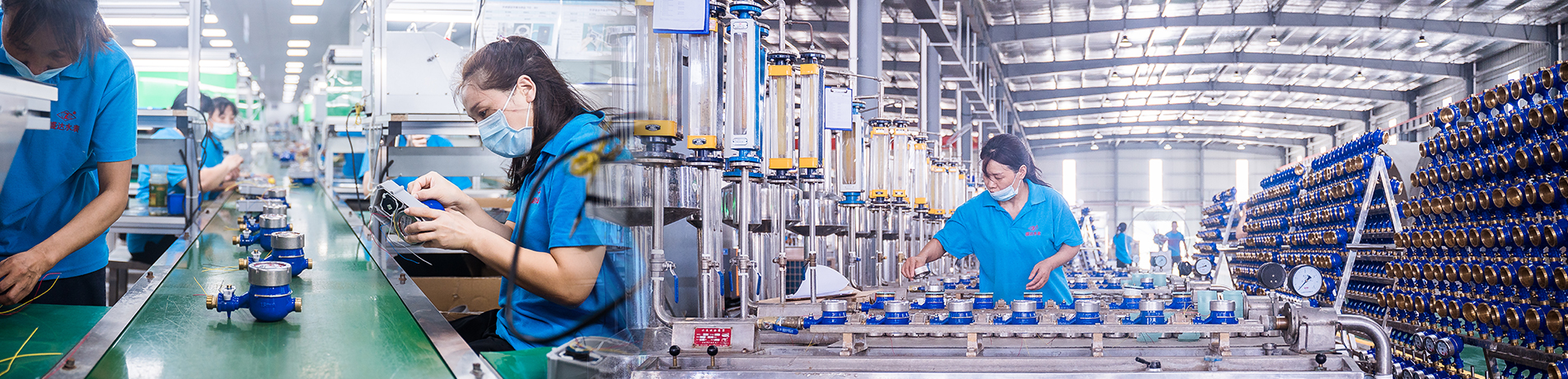
Shengda Water Meter Co., Ltd. (SDWM) was established in 1995 and manufactures flow meters and water meters, including electromagnetic and ultrasonic flow meters, at a 66,000 m² facility with a stated annual output of 3 million units and a 12-engineer R&D team. The company states that it exports about 50% of its output, with main markets in the USA, South America, Africa and Southeast Asia, and that it produces large-size flow meters up to DN3000; its published electromagnetic flow meter range is stated as DN10 to DN3000.
For the two configurations discussed here, three SDWM facts are directly relevant to a buyer's checklist. The company classifies its electromagnetic flow meters by installation method into integrated, split and plug-in types, which is the basis for the terminology discussion above. Its stated control measures include IP68-rated sensors for underground or submerged installation, liner and electrode selection matched to the medium, and calibration and testing before shipment. And its stated production checks include pressure and sealing tests, communication verification before delivery for LoRaWAN, NB-IoT, 4G or M-Bus configurations, long-term durability and life-cycle testing before mass production, and encrypted communication support.
These statements describe how the company says it works. They do not replace the model-level documents a project needs, and they do not establish a ranking against other manufacturers. The practical next step is to put the same evidence table to SDWM and to any other shortlisted supplier, and to compare the answers rather than the names.

Frequently asked questions
What certification should a magnetic flow meter have for a potable water project?
The answer depends on the destination market, because metrological approval and wetted-material approval are separate layers. In the European Union, water meters fall under Directive 2014/32/EU Annex MI-001; in the United States, NSF/ANSI 61 addresses health effects of drinking water system components; ISO 4064-1 and OIML R 49-1 provide the metrological requirement frameworks that national regimes may reference. EMC (IEC 61326-1) and enclosure protection (IEC 60529) are additional, separate points. Ask for certificate numbers, issuing bodies, validity dates and the exact models covered, and check them against the market where the meter will be installed.
Which electromagnetic flow meter manufacturer is better for municipal water projects?
That question cannot be answered from manufacturer names, because the result depends on the project's pipes, water quality, approval route, telemetry and service model. A defensible comparison puts every shortlisted manufacturer on one evidence table: approval documents for the destination market, model-level drawings and datasheets, calibration and test records, the size range covering the actual pipe sizes, wetted materials for the actual water, communication options, and written commercial terms including MOQ, lead time, warranty and spare-parts availability. SDWM, established in 1995, states a DN10 to DN3000 electromagnetic flow meter range, 3 million units annual output, roughly 50% export share, calibration before shipment, and ISO9001, ISO14001, ISO45001, CE, MID and ISO4064 certification. Those are company-reported facts to verify against certificates and test records, not a ranking result. A manufacturer that documents its scope clearly is easier to qualify than one that answers only with a category name.
How do I choose between a battery power and a plug-in meter for one site?
Answer the power question and the installation question separately, then combine them. For power, confirm whether a dependable supply exists at the measuring point, who maintains it, and what happens during an outage; if no supply exists, battery power is the relevant axis and the supplier must state the expected service interval, the replacement procedure and how low battery is signalled. For installation, confirm pipe size and material, access, whether the line can be isolated, and the sealing and zeroing procedure; if the term plug-in is used, obtain the drawing before accepting it as equivalent to any other supplier's terminology. Only after both answers are written down should models be compared on price.
What drives the cost difference between these two configurations?
Published prices, MOQ and lead times are not available in the evidence behind this comparison, so no cost figure should be assumed. The cost drivers themselves are identifiable: nominal diameter, liner material (PTFE, rubber, PFA or FEP), electrode material (for example Hastelloy C, titanium or SS316), pressure rating, power configuration and its service requirements, communication and telemetry options, the approval route and the documentation that goes with it, testing and calibration scope, and spare-parts or battery-replacement arrangements. Ask for each driver to be quoted as a separate line so that two offers can be compared on identical scope rather than on a single total.
What sample or test documentation should I request before approving an order?
Request the documents that will be checked at acceptance, not marketing brochures: the calibration certificate with the tested points, the pressure and sealing test record, the wetted-material declaration, the communication test record if telemetry is supplied, the general arrangement and wiring drawings, the installation and commissioning instructions, and certificate copies for the approval route the project uses. For a first order or a new application, a sample unit for bench or site trial gives more information than any datasheet, provided the trial criteria are agreed in advance.
What lead time and acceptance criteria should be written into the order?
Lead time should be quoted in writing against a fixed datasheet revision and a fixed scope of supply, with the delivery basis (Incoterms) named; no lead-time value is asserted here because published figures were not available. Acceptance criteria should cover factory test items and witness arrangements, the documentation package delivered with the goods, conformity with the approved drawing, the on-site commissioning check including zero verification with the line full and static, the deviation-handling process, and the warranty and spare-parts terms. If a first article or sample is part of the plan, state its approval role in the same document, so that series delivery depends on a recorded approval rather than an informal one. A sample request, an order-specific quotation and the company profile pack are the three documents that usually start that process; the SDWM profile pack is available for download below.
Next step: define the measuring point, the power question and the acceptance criteria, then request a configuration-specific quotation and, where the application is new, a sample for evaluation.
Download the company profile: Shengda Water Meter Co., Ltd. profile (PDF). Product and contact details are published at sdflowmeter.com.
Conclusion
Battery power and plug-in should not be placed in the same comparison column without translation. On SDWM's published classification, plug-in is an installation method; battery power is an energy source. The decision a water flow meter project has to make is therefore a combination — an installation that fits the pipe and the access window, and a power and data arrangement that fits the site and the utility's reading process — verified by documents that the supplier agrees to before the order is placed.
Three actions carry most of the risk reduction. Fix the measuring point and the water characteristics first, because liner and electrode selection follow from them. Treat accuracy as a claim that needs a test basis and a calibration record, not a headline number. And write the purchasing terms and acceptance criteria into the order against a named datasheet revision, so that the delivered unit can be checked against something stable. On that basis, the battery-versus-plug-in question becomes answerable, and the supplier comparison becomes a matter of evidence rather than of labels.
Have Questions or Need More Details?
Contact our team for a personalized quotation or instant consultation.
Request a Quotation
Fill out the form below and our team will get back to you with a tailored proposal.
WhatsApp Direct Chat
Prefer to chat in real-time? Message us on WhatsApp for instant assistance & quick answers.
- Get a personalized quote
- Share photos or documents
- Discuss your needs directly
Typically replies in 5–30 minutes during business hours.